This section is aimed at students in upper secondary education in the Danish
school system, some objects will be simplified and some details will be omitted.
Vector Functions
As mentioned in this section, vector functions are
functions on finite dimensional Euclidean Spaces, i.e.
$$f:\mathbb{R}^n\mapsto\mathbb{R}^m$$
and the objects in the domain and co-domain can be considered \(n\) and
\(m\) dimensional vectors respectively. Higher dimensions can be interesting
for things such as AI research, but we will commonly restrict ourselves to
\(1\leq n,m\leq3\), since this corresponds to our physical world.
Parametric Functions
Parametric functions are simply vector functions where \(n=1\) and
\(m=2,3\), representing planar and spatial functions, respectively. I will
only cover the spatial parametric functions since the planar ones are
completely analogous.
It is common to use the following nomenclature for a spatial vector
functions \(\ul{r}:\mathbb{R}\mapsto\mathbb{R}^3\) with
$$\ul{r}(t)=\begin{pmatrix}x(t)\\y(t)\\z(t)\end{pmatrix}$$
where \(x,y,z:\mathbb{R}\mapsto\mathbb{R}\) are called its
"coordinate-functions" for obvious reasons. Some people, especially
engineers and technicians, may use an arrow above the r rather than the
underline, but it becomes tedious to draw, conflicts with other notation
and means the same thing, namely that the function value is a vector.
Consider the following parametric function
$$\ul{s}(t)=\begin{pmatrix}\sin(t)\\\cos(t)\\\tan(t)\end{pmatrix}$$
so
$$\ul{s}(\pi/6)=\begin{pmatrix}\sin(\pi/3)\\\cos(\pi/3)\\\tan(\pi/3)\end{pmatrix}=\begin{pmatrix}\sqrt{3}/2\\1/2\\\sqrt{3}\end{pmatrix}$$
Derivatives
To find the derivative of a parametric function, you just differentiate
coordinate-wise, i.e. the coordinate-functions. The first derivative
is called the velocity vector with the following notation
$$\ul{v}(t)=\ul{r}'(t)=\begin{pmatrix}x'(t)\\y'(t)\\z'(t)
\end{pmatrix}$$
In reality, we should calculate the difference quotient through a secant
line, but we end up with the same thing
\begin{align}
\frac{\ul{r}(t+h)-\ul{r}(t)}{h}=&\left(\begin{pmatrix}
x(t+h)\\y(t+h)\\z(t+h)\end{pmatrix}-\begin{pmatrix}x(t)\\y(t)\\z(t)
\end{pmatrix}\right)/h\\
=&\begin{pmatrix}(x(t+h)-x(t))/h\\(y(t+h)-y(t))/h\\(z(t+h)-z(t))/h
\end{pmatrix}\to\begin{pmatrix}x'(t)\\y'(t)\\z'(t)\end{pmatrix}
\end{align}
The reason it's called the velocity vector is because it's represents
the instantaneous change in position, and visually it is tangent to
the graph. We can do this one more time to get the acceleration vector, i.e.
$$\ul{a}(t)=\ul{v}'(t)=\ul{r}''(t)=
\begin{pmatrix}x''(t)\\y''(t)\\z''(t)\end{pmatrix}$$
where this vector represents the instantaneous acceleration and is
represents visually which way the graph is "curving".
We can take any of these parametric functions and turn them into a
single dimensional function by taking the length of the vectors, i.e.
$$v(t)=|\ul{v}(t)|=\sqrt{x'(t)^2+y'(t)^2+z'(t)^2}$$
which represents the absolute speed and acceleration respectively.
Lets differentiate the parametric function from the previous example
$$\ul{v}(\pi/3)=\ul{s}'(\pi/3)=\begin{pmatrix}\cos(\pi/3)\\-\sin(\pi/3)\\(\cos(\pi/3))^{-2}\end{pmatrix}
=\begin{pmatrix}1/2\\-\sqrt{3}/2\\(1/2)^{-2}\end{pmatrix}=\begin{pmatrix}1/2\\-\sqrt{3}/2\\4\end{pmatrix}$$
$$\ul{a}(t)=\ul{v}'(t)=\ul{s}''(t)=\begin{pmatrix}-\sin(\pi/3)\\-\cos(\pi/3)\\\frac{2\sin(\pi/3)}{\cos^3(\pi/3)}\end{pmatrix}
=\begin{pmatrix}-\sqrt{3}/2\\-1/2\\\frac{2\sqrt{3}/2}{(1/2)^3}\end{pmatrix}=\begin{pmatrix}-\sqrt{3}/2\\-1/2\\8\sqrt{3}\end{pmatrix}$$
with
$$|v(\pi/3)|=\sqrt{\cos^2(\pi/3)+(-\sin(\pi/3))^2+((\cos(\pi/3))^{-2})^2}=\sqrt{1+4^2}=\sqrt{17}$$
and
$$|a(\pi/3)|=\sqrt{1+8^2\cdot3}=\sqrt{193}$$
Curve length
To calculate the curve length, we can integrate the "speed" in the interval, i.e.
Curve Length
Assume that the function \(s(t)\) represents a one dimensional position on the curve,
e.g. by assuming that \(s(0)=0\). Then the curve length \(L\) from \(t=t_0\)
to \(t=t_1\) is the distance covered in the same interval, i.e.
$$L=s(t_1)-s(t_0)=\int_{t_0}^{t_1}s'(t)dt=\int_{t_0}^{t_1}|\ul{s}'(t)|dt=\int_{t_0}^{t_1}\sqrt{x'(t)^2+y'(t)^2+z'(t)^2}dt$$
Lets find the curve length from \(t_0=\pi/6\) to \(t_1=\pi/3\)
$$L=\int_{\pi/6}^{\pi/3}\sqrt{1+(\cos(t))^{-4}}dt\approx1.28$$
Functions of Multiplie Variables
Another interesting use-case is the opposite of the parametric functions,
where \(n=2,3\) and \(m=1\). This time I will choose the lower value for
n, since this has interesting visualizations. The nomenclature here is
\(f:\mathbb{R}^2\mapsto\mathbb{R}\) with
$$z=f(x,y)$$
which has a graph that is a three dimensional surface, which can be used
to represent a hillscape, among other things.
As an example of a function of two variables is the following function
inspired by quantum mechanics
$$f(x,y)=2\sin(\pi x)\cos(y)$$
its graph is similar to the image below.
Sectional Functions
Just like with the parametric functions we can turn multivariate into
a single variable function by relating \(x\) to \(y\). So for some
function \(g:\mathbb{R}\to\mathbb{R}\), which I will call "sectioning"
function, we can construct what I will call the "sectional" function
\(p:\mathbb{R}\to\mathbb{R}\)
$$p(x)=f(x,g(x))$$
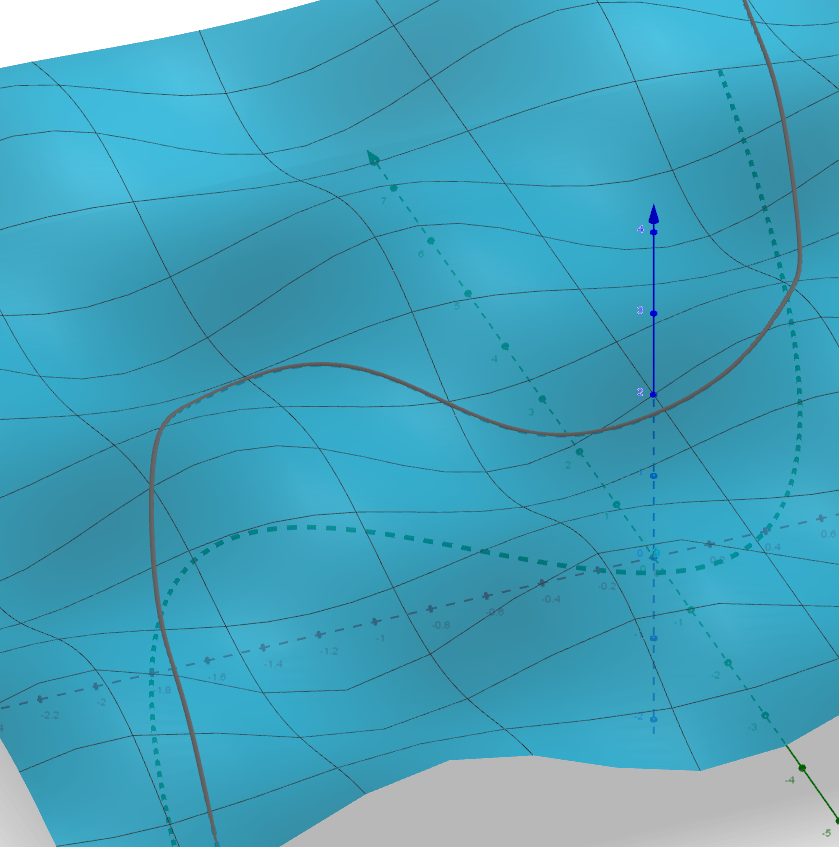
which sections the surface by the graph of \(g\). On the following image
you can see the graph of the sectioning function on the \((x,y)\)-plane
and how it sections the surface.
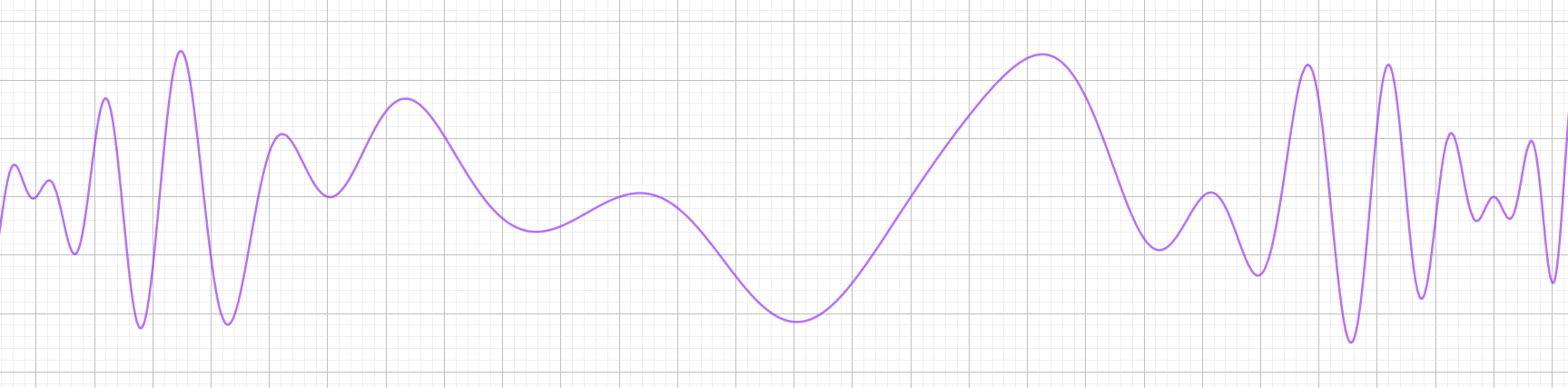
If this surface represented a hillscape, then the sectional function
would describe the our height as we followed the path of the sectioning
function, and looking along the y-axis it would look like the following
image
Two sectioning functions that are of particular interest are constant
functions, representing cross-sections that are parallel to the axes.
These are then \(v(x)=f(x,k)\) and \(u(x)=f(k,x)\).
Derivatives
In this case, it's not easy to consider one tangent, because it could
go in any direction, so what we do is we create a so-called
directional-derivative
$$f_v'(\ul{r})=\lim_{h\to0}\frac{f(\ul{r}
+h\ul{v}^*)-f(\ul{r})}{h}$$
where the * denotes a unit vector in the direction of v.
Lets find the derivative in the direction of \(\ul{v}=\begin{pmatrix}\cos(\pi/3)\\\sin(\pi/3)\end{pmatrix}\)
$$f_v'(x,y)=\lim_{h\to0}\frac{2\sin(\pi(x+h\cos(\pi/3)))\cos(y+h\sin(\pi/3))-2\sin(\pi x)\cos(y)}{h}$$
$$=\lim_{h\to0}\frac{2\sin(\pi x+h\pi/2)\cos(y+h\sqrt{3}/2)-2\sin(\pi x)\cos(y)}{h}$$
$$=2\pi\cos(\pi x)\cos(y)\cos(\pi/3)-2\sin(\pi x)\sin(y)\sin(\pi/3)$$
$$=\pi\cos(\pi x)\cos(y)-\sqrt{3}\sin(\pi x)\sin(y)$$
I will explain below how I did the last two calculations, but this function tells us the slope
of the graph in the direction of \(\ul{v}\). If we choose to section the graph by \(y=\pi x\) we get
$$f_v'(x,\pi x)=\pi\cos^2(\pi x)-\sqrt{3}\sin^2(\pi x)$$
One consequence of this is that along the line \(y=\pi x\) the slope in the
direction of \(\ul{v}\) alternates between \(\pi\) and \(-\sqrt{3}\).
But it turns out that it's
unnecessary to consider all directions at once, we can focus on the
horizontal and vertical tangents. These correspond to so-called
partial-derivatives.
Partial Derivatives
For the multivariate function \(f(x,y)\) and the corresponding
cross-sectional functions \(v_k(x)=f(x,k)\) and \(u_k(x)=f(k,x)\), we
define the partial derivative with respect to \(x\) as
$$\frac{\partial f}{\partial x}(x,y)=v_y'(x)$$
with respect to \(y\)
$$\frac{\partial f}{\partial y}(x,y)=u_x'(y)$$
and the corresponding "gradient" as
$$\nabla f(x,y)=\begin{pmatrix}\frac{\partial f}{\partial x}(x,y)\\
\frac{\partial f}{\partial y}(x,y)\end{pmatrix}$$
Lets find the partial derivatives and gradient from the previous example
$$f_x'(x,y)=2\pi\cos(\pi x)\cos(y)$$
$$f_y'(x,y)=-2\sin(\pi x)\sin(y)$$
$$\nabla f(1/3,\pi/6)=\begin{pmatrix}2\pi\cos(\pi/3)\cos(\pi/6)\\-2\sin(\pi/3)\sin(\pi/6)\end{pmatrix}$$
$$=\begin{pmatrix}2\pi\frac{1}{2}\frac{\sqrt(3)}{2}\\-2\frac{\sqrt{3}}{2}\frac{1}{2}\end{pmatrix}$$
$$=\frac{\sqrt{3}}{2}\begin{pmatrix}\pi\\-1\end{pmatrix}$$
We can relate this to the directional derivative by the following
proposition
The direction of the heighest growth is then the direction that
makes this scalar product have the heighest value, which obviously
is in the direction of the gradient. The magnitude of the gradient is
the greatest slope at that point since
$$ f_{\nabla f}'(x,y)=\frac{\nabla f}{|\nabla f|}\bullet\nabla f(x,y)=\frac{|\nabla f|^\cancel{2}}{\cancel{|\nabla f|}}(x,y)$$
Furthermore, this also implies that the gradient being the zero vector implies
that the slope is zero in any direction, which is a necessary and sufficient condition
for a stationary point.
This allows us to state the well known theorem on stationary points which are
points where "action" halts, i.e. the slope is zero, which is to say that all
the directional derivatives are all zero, but all we need here is that the
gradient is zero by the previous theorem.
Stationary Points
A stationary point is a point on a surface where all derivatives are zero.
On a surface of a multivariable function, this specifically means that the
gradient is zero at that point, i.e.
$$\nabla f(\ul{x})=\ul{0}$$
It should be noted that these points are technically the full dimensional object,
but if it lies on the graph of a function, it can be referred to by the domain
since last coordinate will be inferred from the function. For example, the
stationary point of \(f(x,y)=x^2+y^2\) is \((0,0,0)\) but you could also state
it as being \((0,0)\) where you can infer the full point as \((0,0,f(0,0))\).
These stationary points can have two clearly defined "types", depending on
how they are formed. If we have a stationary point which curves "differently"
in two different directions, we have a so-called saddle-point. If the curvatures
are similar in all directions, we will have an extremum, assuming that the torsion
isn't too great. This involves the second partial derivatives and can be stated as follows.
Types of Stationary Points
We compare the curvature and torsion at the point, which can be expressed as
the determinant of the "Hesse matrix".
$$\begin{vmatrix}f_{xx}''&&f_{xy}''\\f_{yx}''&&f_{yy}''\end{vmatrix}=f_{xx}''f_{yy}''-f_{xy}''f_{yx}''$$
1. If this number is positive, there is more curvature than there is torsion, and we have an extremum.
2. If this number is negative, the torsion is stronger than the curvature, and we have a saddle-point.
3. If they are equal, it is generally a more complicated shape, which would require further analysis.
Derivative of composites
Let \(s:\mathbb{R}\to\mathbb{R}^2\) with \(s(t)=\begin{pmatrix}x(t)\\y(t)\end{pmatrix}\) and \(g:\mathbb{R}^2\to\mathbb{R}\)
be differentiable in all variables, then the composite function \(f=g\circ s:\mathbb{R}\to\mathbb{R}\)
is also differentiable and the derivative can be calculated as follows
$$f'(t)=\nabla g(\ul{s}(t))\bullet \ul{s}'(t)$$
Proof.
$$f'(t)=\lim_{h\to 0}\frac{f(t+h)-f(t)}{h}$$
$$=\lim_{h\to 0}\frac{g(\ul{s}(t+h))-g(\ul{s}(t))}{h}$$
$$=\lim_{h\to 0}\frac{g(x(t+h),y(t+h))-g(x(t),y(t))}{h}$$
$$=\lim_{h\to 0}\frac{g(x(t+h),y(t+h))-g(x(t),y(t+h))+g(x(t),y(t+h))-g(x(t),y(t))}{h}$$
$$=\lim_{h\to 0}\frac{g(x(t)+k_x,y(t+h))-g(x(t),y(t+h))}{k_x}\frac{x(t+h)-x(t)}{h}+\frac{g(x(t),y(t)+k_y)-g(x(t),y(t))}{k_y}\frac{y(t+h)-y(t)}{h}$$
$$=g_x'(\ul{s}(t))x'(t)+g_y'(\ul{s}(t))y'(t)=\nabla g(\ul{s}(t))\bullet \ul{s}'(t)$$
where \(k_x=x(t+h)-x(t)\) and \(k_y=y(t+h)-y(t)\)
∎
This represents how "annoying" it is to traverse the graph of \(g\) by following the path of \(\ul{s}\) since
$$f'(t)=\nabla g(\ul{s}(t))\bullet \ul{s}'(t)=g_{s'(t)}'(\ul{s}(t))|\ul{s}'(t)|$$
so the derivative of \(f\) is the directional derivative of \(g\) in the direction of \(\ul{s}'\)
multiplied by the speed at \(\ul{s}(t)\). If there is no slope, then it's not annoying, and
if you're not moving, it's not annoying.